

When I got accepted into the Service Business Innovation Accelerator (SBIA) for service businesses, one of the core challenges put to the cohort was this: identify areas of your business you can productise, and then actually build it.
For me, the ‘identify’ part was easy. I already had a few ideas I was considering, so the ‘build’ part was the experiment. I come from a development and product management background, so I’m no stranger to shipping software or writing a decent prompt. But I had never used an AI development platform before. Replit was new territory, and the SBIA cohort gave me the perfect reason to finally dive in.
What Is Replit?
Replit is a browser-based development platform with AI-assisted coding built right in. You can write, run, and deploy software entirely in the browser, no local environment setup, no context-switching between tools.
Think of it as a lightweight, accessible way to bring ideas to life, especially if you’re not a full-time developer. For founders exploring productisation, it removes one of the biggest barriers: getting started.
With tools like Replit, you can quickly spin up a prototype, MVP, or a web application as I did.
What We Do at Tehillah Solutions
At Tehillah Solutions, we help visionaries, creatives, and founders move from idea → clarity → execution. One way we do this is by helping aspiring and emerging authors find their voice, clarify their message, and actually write their books.
The 30-Day Writing Challenge is one of our flagship offerings, a structured, guided journey designed to help authors build consistency, develop their authorial voice, and make real progress on their writing goals.
The Product I Chose to Build
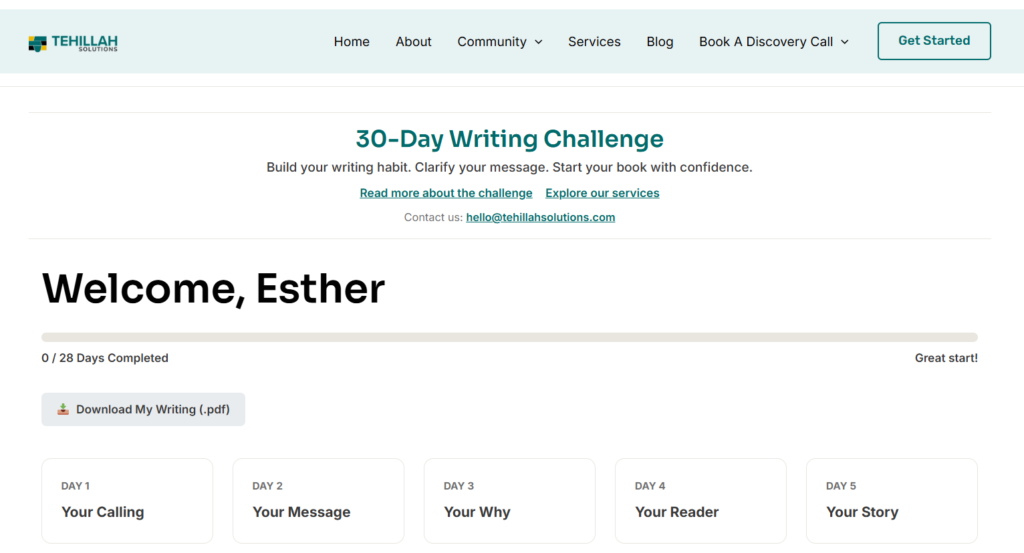
I wanted the 30-Day Writing Challenge to be more than a PDF or email prompts. It was to support three critical outcomes for aspiring authors:
- Clarity – helping them refine what they want to say
- Consistency – building a daily writing habit
- Completion – actually finishing something meaningful
It was to be an interactive experience, a personalised web dashboard that could hold the experience together and give authors a tangible sense of progress as they move through the challenge.
The Product Scope and Constraints
Before writing any prompt, I defined clear constraints:
- It had to work on the free plan
- It needed to be simple but functional
- It should be portable (i.e., usable outside Replit)
- No backend dependency, just a static HTML-based tool
And authors should be able to:
- Track their daily writing progress
- Maintain streaks to reinforce consistency
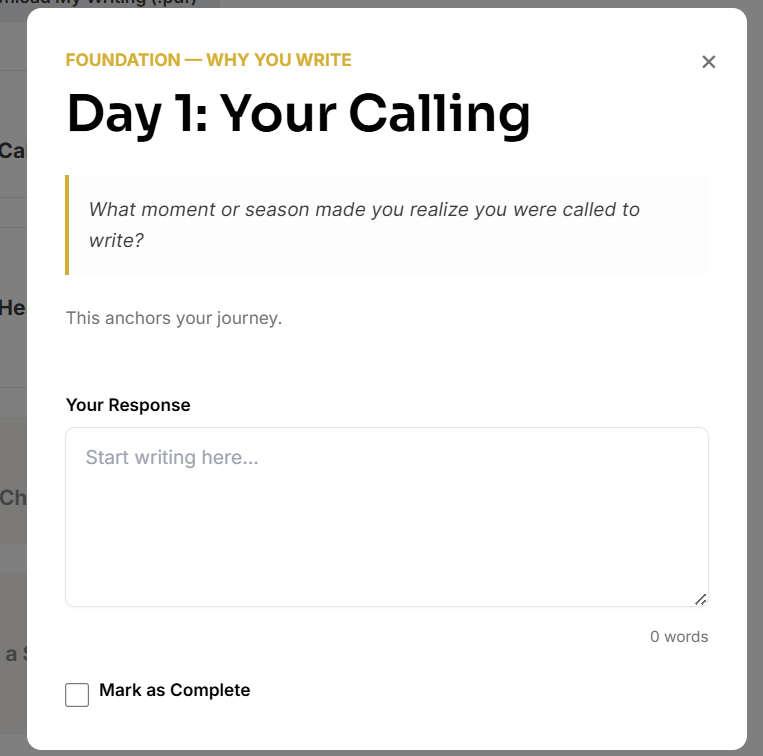
- Write and save their daily entries within the platform
- Download their write-ups — because those words belong to them, and become a significant part of their authorship journey
I also structured the challenge in a weekly advent-style format, giving the experience a rhythm that builds week by week rather than feeling like a flat 30-day countdown.
How I Built It
I had a clear sense of what I wanted and how to think about the build strategically. But this was my first time using an AI development platform, so there was still a learning curve in understanding how to work with Replit effectively rather than just throwing requirements at it.
Here’s what worked well:
1. Design Mode First: I used Replit’s design capabilities to quickly shape the interface and user flow before worrying about deeper functionality.
2. Using Claude to sharpen my prompts before touching Replit. My product background told me that clarity upfront saves time downstream. I used Claude to help me ideate and refine what I actually wanted to build before writing a single prompt in Replit. The quality of what you get out is directly tied to the quality of what you put in — and that’s true whether you’re writing a spec or prompting an AI builder.
3. Being deliberate about the technical architecture. I made an explicit decision early on: I wanted this built as a static HTML file. No backend dependency, no reliance on Replit’s infrastructure to keep it running. That decision gave me full portability, meaning I can host the code directly on the Tehillah Solutions website if I want to, completely independent of the platform it was built on. This decision made the tool portable, lightweight, and cost-efficient.
Cost & Build Reality
I ran the majority of the build on Replit’s free plan. The only reason I upgraded to the paid Core tier was impatience. Once I started layering in features like streaks and the download functionality, I didn’t want to sit around waiting for the daily AI credit refresh to continue iterating.
Total development cost: approximately $24.
For something that would traditionally take weeks (or cost hundreds/thousands), this was a clear shift in how quickly founders can now prototype real products.
Key Reflection: Speed Changes Everything
This experience reframed how founders should think about building:
- You don’t need a full dev team to start
- You don’t need a large budget to test an idea
- You do need clarity on the outcome you’re building for
More than anything, it reinforced that productising your service doesn’t have to be overwhelming; you can start with a simple (internal) tool.
What’s Next
This tool will now be integrated into our 30-day writing challenge experience.
Join the challenge here. If you’re an aspiring author looking to clarify your message and build consistency, this is for you.
Over to You
Have you built with Replit or any AI development platform?
if you’ve been sitting on an idea for a tool your business needs, what would you build first?
Share in the comment section, I’ll be reading